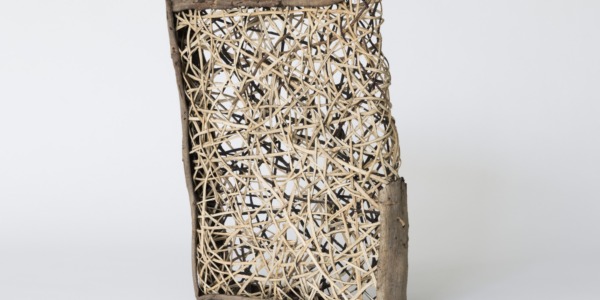
《Grasp Ⅷ》2026/ h40.0cm / jasmine, walnut
Hisako Sekijima (b. 1944) makes basketry works using plant materials. Basketry refers both to the techniques used to make baskets and to the objects made with them. Although Sekijima’s works are baskets, they are not intended to hold anything. Sekijima focuses on the principles of interlacing, giving form to her ideas about basic fabricating methods such as twining, knotting, plaiting, and warp/weft weaving; the varied properties of plant materials; and the forms that emerge from combining materials and techniques. In Sekijima’s case, the work is not simply the finished object but the thinking behind it: a process in which questions and hypotheses lead to discoveries and further ideas. A key part of her work’s appeal lies in the clarity and directness with which she gives that thinking physical form.
Sekijima encountered American craft during a four-year stay in New York in the late 1970s. There, she saw artists adapting traditional techniques to create contemporary works and began to see baskets as a form of textile art. After returning to Japan, she took Japanese mingu (functional vessels and tools used in traditional rural life) as her starting point for reexamining old functional objects from around the world that were made by interlacing. Drawing on earlier research as well, she gradually established a way of working in which she approached interlacing from a universal perspective and developed her ideas on that basis.
Sekijima’s analytical approach to her art conveys the joy of thinking and the thrill of discovery. Featuring works from the 1980s to the present, the exhibition explores how Hisako Sekijima’s ideas about interlacing have developed and taken shape in her work.
| Venue: | Kikuchi Kanjitsu Memorial Tomo Museum |
| Starts: | November 14, 2026 |
| Ends: | March 22, 2027 |
Minato-ku, Tokyo
105-0001 JP
Cost: Adults 1,500yen, University Students 1,000yen, High School Students and Younger Free